
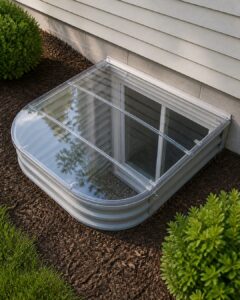
Short answer: yes. If someone sleeps in a room below grade in Colorado, that room needs an emergency escape opening, and if the opening sits below ground level, it needs a window well built to code.
I’ve been working on homes along the Front Range for more than 25 years, and this is one of the questions I hear most from people finishing a basement or getting ready to sell. Usually the question comes with a little hope attached. “The old window is probably fine, right?” Sometimes it is. Often it isn’t. Here’s how to tell, and why the rule exists in the first place.
Why the Rule Exists
A basement bedroom has one obvious way out: up the stairs. In a house fire, that staircase can fill with smoke in minutes, and it’s often the first route to become unusable. An egress window gives whoever is sleeping down there a second way out. It also gives firefighters a way in.
Colorado municipalities, including Fort Collins, build their residential codes on the International Residential Code (IRC). Under that code, every sleeping room in a basement needs its own emergency escape and rescue opening. Not one per basement. One per bedroom. A basement with finished living space but no bedrooms generally still needs at least one.
What the Code Actually Requires
There are two parts to this: the window itself and the well outside it. Both have to pass.
The window
The opening has to provide at least 5.7 square feet of clear space when fully open. (That drops to 5.0 square feet if the window opens directly at ground level, which is rare in a basement.) It must be at least 20 inches wide and 24 inches tall, and those minimums don’t automatically add up to 5.7 square feet, so you need to hit both the dimensions and the total area.
The sill can’t sit more than 44 inches above the finished floor. Picture a child or an older adult trying to climb out in the dark. That’s the reason for the limit.
The window also has to open fully from the inside with no keys, tools, or special know-how. A painted-shut slider or a window that only cracks open a few inches doesn’t qualify, no matter its size.
The well
The window well needs at least 9 square feet of floor area, with a minimum of 36 inches in both width and projection out from the foundation. That space is what lets someone actually get through the window and stand up outside it.
If the well is more than 44 inches deep, it needs a permanently attached ladder or steps. The ladder can’t block the window from opening, and it can’t extend more than 6 inches into that required 36-inch space.
One detail people miss: any cover, grate, or bars over the well also have to be releasable from inside without tools or unusual strength. A heavy, bolted-down cover can turn a compliant well into a trap. When we install covers over egress wells, this is something we check every time.
The Situations Where This Comes Up
Finishing a basement. If you’re adding a bedroom, egress is part of the permitted scope. The inspector will measure it.
Converting an existing room into a bedroom. That “office” or “bonus room” with a small hopper window might be fine as an office. The moment it becomes a sleeping room, the rules change.
Selling your home. Listing a basement room as a bedroom when it lacks a legal egress opening can create problems with appraisals, buyer inspections, and disclosures. I’ve seen deals stall over it.
Older homes. Code requirements have shifted over the decades, and a basement that was finished legally years ago may not be held to today’s standard unless you remodel or change how the space is used. That said, “it was grandfathered” doesn’t make the room any safer if someone is sleeping there. The City of Fort Collins Building Services office can tell you what applies to your specific situation, and I’d always check with them before making assumptions.
Where the Window Well Fits In
Most homeowners focus on the window and treat the well as an afterthought. In practice, the well is where a lot of egress setups fail. I regularly see wells that are too narrow for the window to swing open, too deep without a ladder, or rusted and pulling away from the foundation so badly that climbing out would be a real hazard.
A compliant well also has to do its everyday job. It needs a gravel base and drainage underneath so a bigger opening doesn’t become a bigger path for water. In Fort Collins clay soil, that part isn’t optional.
Our approach is to match the well to the window and the home: correct sizing, a ladder when the depth calls for it, a water-tight gasket seal at the foundation, and our patented mounting system that keeps the metal well from contacting the foundation rebar, which is the root cause of most premature rust we see in this area. We hand-dig to keep disruption to your yard as small as possible.
Frequently Asked Questions
Does every basement bedroom need its own egress window?
Yes. Under the IRC, each sleeping room needs its own emergency escape opening. Two bedrooms sharing one egress window in a hallway or adjacent room won’t pass.
Can a door count as the egress opening instead of a window?
It can. A door that leads directly outside, such as a walkout basement door, can satisfy the requirement for that room. For most Colorado basements that sit fully below grade, though, a window and well is the practical option.
My basement window is close to the right size. Is “close” good enough?
Unfortunately not. Inspectors measure the net clear opening, and falling short by even an inch in width or height is a fail. If you’re unsure, measure the opening with the window fully open, not the frame.
When does an egress window well need a ladder?
When the well is deeper than 44 inches from the top of the well to the bottom. The ladder has to be permanently attached and can’t interfere with the window opening or reduce the required floor space by more than 6 inches.
Do I need a permit to add an egress window in Fort Collins?
In most cases, yes. Cutting a new opening or enlarging an existing one in a foundation wall typically requires a building permit and inspection. Replacing a damaged well with one of the same size is a different situation. Check with the city or ask us, and we’ll point you in the right direction.
Can I put a cover on an egress window well?
Yes, and in Colorado it’s a good idea. The cover just has to be easy to push open or release from inside without tools. A clear, lightweight cover keeps out snow, debris, and kids or pets while still allowing a quick exit.
Make Sure Your Basement Bedroom Is Ready for the Worst Day
An egress window well is one of those things you hope never matters. But if it ever does, it has to work the first time, in the dark, under stress. Getting the size, depth, ladder, and cover right is what makes that possible.
Window Well Solutions has served homeowners from Fort Collins to Denver for over 25 years. We’ll look at your current setup, tell you honestly whether it meets egress requirements, and build a well that keeps your family safe and your basement dry, backed by our 10-year warranty. We also serve homeowners in Severance, Longmont, Thornton, Wellington, Loveland, Berthoud, Broomfield, Johnstown, Westminster, Brighton, Denver, Arvada, Erie, Greeley, Lafayette, Louisville, rusty window well replacement in Denver, as well as window well covers in Denver.
Contact Window Well Solutions at 970-691-8514 or request a free estimate at wws-co.com.